Case 02 · Library prioritization
Prioritizing 1,000 molecules: filter first, then infer
A 1,000-molecule customer library was first filtered on physicochemical properties, then the passing molecules went through activity, ADMET, synthesizability and DTI to produce an interpretable ranking. This case is a 2D snapshot without molecular docking; it demonstrates fast prioritization of a small-to-medium library, not billion-scale screening.
Run parameters
| Run date | 2026-09-23, local real run |
|---|---|
| Target | CHEMBL4247 |
| Input size | 1,000 molecules from a customer library |
| Method | 2D screening · activity / ADMET / synthesizability / DeepPurpose DTI |
| Runtime | Physicochemical filtering 0.8 s · activity ~20 s · ADMET ~43 s · synthesizability ~28 s |
| Not performed | Molecular docking, wet-lab validation |
Screening funnel
| Stage | Count | Note |
|---|---|---|
| Library molecules | 1,000 | Customer-owned library |
| Passed physicochemical prefiltering | 754 | 246 never entered inference, saving compute |
| Passed combined constraints | 712 | Activity / ADMET / synthesizability combined |
| Reported candidates | 20 | Top 20 by composite score |
Top 1 by composite score
The ranking is a prioritization result, not an activity determination. Composite weights are adjustable; evaluate a candidate together with predicted activity probability, ADMET risks and synthetic feasibility.
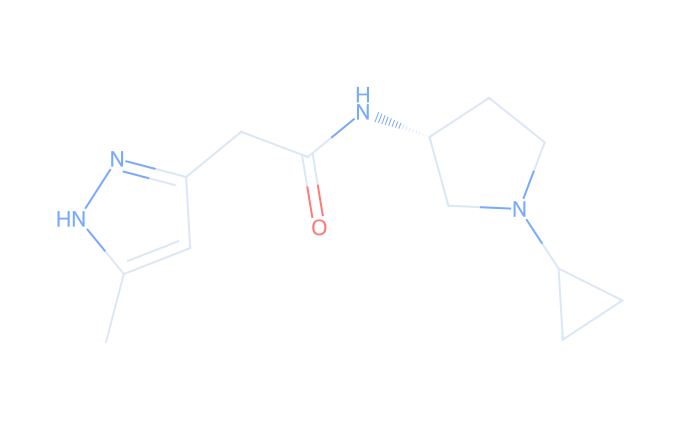
| Composite score | 74.9 |
|---|---|
| Activity probability | 0.5583 |
| Predicted pIC50 | 7.39 (ranking reference, not a measured value) |
| SAscore | 2.94 |
| Molecular weight | 248.33 |
| LogP | 0.61 |
| QED | 0.821 |
| SMILES | Cc1cc(CC(=O)N[C@@H]2CCN(C3CC3)C2)n[nH]1 |
What this case does not show
- This was a ligand-based (2D) screen without molecular docking. The platform does support 3D docking: run a 2D coarse screen, then refine Top N with Vina.
- The library scale is 10³ (1,000 here). The positioning is fast prioritization of small-to-medium libraries, not billion-scale screening.
- Activity prediction is a QSAR ranking, not an activity determination; ADMET values are predictions, not measurements.
- All results require wet-lab confirmation and cannot be used directly for regulatory submission.
Citation note: when quoting these numbers, keep the qualifiers “local real run on 2026-09-23, 2D snapshot, not validated in wet lab”.